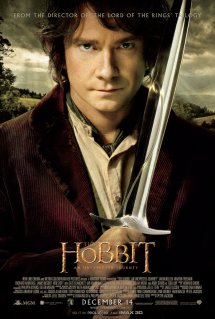
And so the obsession begins again. You can also read my reviews of "
Lord of the Rings"
1,
2, and
3.
 |
| You will consume the bulk of my thoughts and actions for the next three years. |
If you're hoping to go into theaters this winter and see "The Hobbit: A Thrilling Prequel to the Lord of the Rings," congratulations, I think you'll thoroughly enjoy about half of this movie. If you're hoping for "The Hobbit: An Adaptation of the Beloved Children's Story," you'll thoroughly enjoy the
other half of this movie. The problem with "The Hobbit: An Unexpected Journey" is that it can't commit to being one or the other, and the result is complete tonal whiplash between whimsy and aggressive grandeur.
But let's back up for a moment and talk about the eighties.
My main cinematic influences growing up were Disney, of course, and Jim Henson. Like many children, I watched a lot of Sesame Street, a lot of the Muppet Show and Muppet movies, "Star Wars," and the full battery of live-action fantasy movies with Henson's puppet creations, the most memorable in my mind being "Labyrinth." When you thought of live-action fantasy, you thought first and foremost of Jim Henson's beautiful and whimsically grotesque creations.
 |
| And David Bowie's magnificent package. |
Fantasy didn't get much better than Jim Henson. That was the problem. I love Jim Henson as much as the next red-blooded American, but he was limited by budget and technology to movies and creations that looked fake. I'm not saying they didn't look
good; he certainly knew how to make a fully-realized fantasy world and inhabit it with interesting-looking creatures. And the low-budget-ness art production of "Labyrinth" and "Dark Crystal" is part of their charm. Yes, the rocks are all clearly made of foam and the backgrounds are all matte paintings, but you can say the same of the original "Star Trek" and "Doctor Who" television series. Realism is completely beside the point of these creative properties. They're supposed to take place outside of the real world. It's okay for them to look fake, even aggressively artificial, because it fits thematically with stories set in the realm of pure imagination.
 |
| Imagine my slave laborers want to toil in my factory. |
Peter Jackson's "Lord of the Rings" trilogy changed all of that. He created the first live-action fantasy film that strove for verisimilitude (and he succeeded because he was given the time and resources to turn the nation of New Zealand into his own personal sound stage). The face of live-action fantasy when from this--
to this:
Not to be hyperbolic, but in terms of the evolution of film, LOTR was basically the moment when we started making tools and fire instead of just squatting in a dark cave cramming moss and raw lizard tails down our gullets.
So it's going to sound a little weird when I say that "The Hobbit" needed less Peter Jackson and more Jim Henson; it needed to be closer to "Labyrinth" than LOTR.
I can remember the exact moment when I had this thought. It was in the scene when the dwarves are captured and brought before the Goblin King in Goblintown. The King makes his "I got you!" speech and has his little minion take a letter, and then the minion goes zooming away down a zip-line in his little cage to deliver the letter. Right then I thought, "Jim Henson lives!" The design of the minion, the way he moved, and the whole concept of that pipsqueak goblin secretary zipping around Goblintown in his cage delivering the words of the Goblin King was straight out of Jim Henson Studios.
It was perfect. Perfect for an adaptation of "The Hobbit." Perfect for a live-action fantasy movie aimed at children. Perfect for the whimsical world of Tolkien's beloved children's novel. This was "The Hobbit" movie I wanted to see.
And there wasn't enough of that overall. There wasn't enough whimsy or charm. There was too much war, too much gravitas, too much--well, I felt like the old Reese's peanut butter commercials: "You got Lord of the Rings in my Hobbit!"
I'm not saying that I disliked the movie. As the BF said after our first viewing, "It wasn't a bad movie. It wasn't even a mediocre movie." It was a good movie (as you can tell by my use of the the phrase "first viewing"). It just wasn't a great movie, because it couldn't decide what kind of movie it wanted to be, or what demographic it wanted to appeal to the most.
Four main examples of where this movie went wrong, and let's put a big damn
SPOILER alert at this point for both the movie and the books:
1) Radagast the Brown. Why? Just
why? Ten years ago I read LOTR and thanked all the stars in heaven that Jackson didn't feel the need to immortalize Tom Bombadil on screen, but apparently he was just saving that nonsensical embarrassment of a character for "The Hobbit." The only people who would find Radagast the Brown funny or compelling, with the fidgeting and the capering and huge streak of bird shit down his face, are five-year-olds. And you can't take a five-year-old to see this movie! Right after Radagast saves his little hedgehog friend and dashes off on his bunny-sled, he's almost stabbed by a ghostly wraith and gets chased out of an evil fortress by an unholy abomination from the deepest pits of hell. You need to be at least ten, or a very brave eight, to see this movie without screaming and crying and demanding to leave the theater. And yet the rest of us have to suffer through several agonizing minutes with Radagast the Teletubby that don't even advance the main plot.
2) Speaking of things that don't advance the plot, why that long, boring scene of the wizards and elves sitting around a table talking to each other? Saruman, Gandalf, Elrond and Galadrial all gather in Rivendell to discuss the bad shit going down these days. This is the clearest thematic and story tie-in to LOTR, because of course they're really talking about the rise of Sauron, which is kind of a big deal in the other movies. But it's an awful scene. It's boring, grinds the story to a screeching halt, commits the fatal sin of telling rather than showing, and again, I can't imagine who it's supposed to appeal to.
If you read the books, you don't need to be told that the Necromancer is the first sign of the second rise of Sauron. If you only watched the LOTR movies and didn't read the books, you'd at least recognize that the evil ghost in the big scary castle is one of the Ringwraiths that were heavily featured in
all three LOTR movies. Gee, could there be a connection there? And if you didn't read the books and didn't watch any of the previous movies, then all this means nothing to you and will just leave you wondering why you're wasting your time with these tall magical people talking gravely at each other, when you paid good money to watch thirteen short hairy people and one short fussy person go on an adventure.
3) The subplot with the Pale Orc seeking revenge against Thorin made me roll my eyes so much they nearly fell out of my skull. The BF railed hard against this character. "So now we have to sit through this stupid son-must-avenge-the-father revenge story? It cheapens the whole movie! It wasn't in the book and anyway it's been done! It's been done to death, and it's not what "The Hobbit" is about!
Why?"
The weird thing is, I can see the reasoning behind the character of the Pale Orc and his blood-feud with Thorin. It's meant to make Thorin more like Aragorn in LOTR (they even look alike, what a coincidence), to give him nobility and a higher purpose in this story than just reclaiming gold and treasure from Smaug the Dragon. It's also meant to spice up the story by giving Jackson an excuse to show some of the Dwarf and Goblin Wars in flashback, which, I admit, looked pretty cool on screen but don't otherwise figure into the main story at all.
But even though the Pale Orc subplot was much more interesting and advanced the story more than the two previous examples on this list, it's actually the one I hated the most. Thorin
isn't Aragorn. He isn't the dark, brooding hero reluctantly stepping forth from his self-imposed exile to accept his great destiny. Thorin in the book is pompous, long-winded, a little arrogant, and a little too eager to call himself King and lay claim to greatness he doesn't necessarily achieve. He's not exactly a hero in the traditional sense, but he
thinks he is, and that's what makes him compelling.
The problem from a movie-making perspective is that all of Thorin's best character development comes at the end of the book, when the dwarves have recovered the treasure and Thorin sits in his grandfather's seat as King Under the Mountain. And if you're a movie director making "The Hobbit" into a trilogy, you can't wait until the second half of the last movie to explore what Thorin Oakenshield is really about. Which brings us to...
4) This movie is too long for the amount of story it tells. As soon as the credits started to roll after almost three hours of footage, the BF and I both said, "I want to see a theatrical cut of that movie." We wanted "The Hobbit: An Unexpected Journey" with the fat trimmed off, without Radagast, the mini-Council of Elrond, or the Pale Orc, which really belong in the extended edition of this movie, not in the theatrical release (if they even have a place in this movie at all, which I don't think they do). If this is what Jackson created with the extra time and breathing room he has by making "The Hobbit" into three movies, I'm thinking that he should have stuck with his original plan to just make two. Almost everywhere he's added to or deviated from the source material, it was intended to make "The Hobbit" more like "Lord of the Rings" in either story or tone, and those were inevitably the worst parts of the movie.
Because here's the thing: "The Hobbit" can clearly stand on its own as a movie, without allusions to the rise of Sauron or parallels to LOTR characters. The parts of this movie that were done right, that made me smile and made my heart soar, were lifted straight from the pages of the book: the party that Bilbo reluctantly hosts for the rowdy dwarves in his hobbit-hole; the scene with the trolls in the woods; and the whole glorious sequence in Goblintown where the dwarves and Gandalf fight their way out out of the mountain while Bilbo trades riddles with Gollum beside the subterranean lake. Those were all in the book and they all translated perfectly to the screen.
Jackson didn't need the extra stuff, and he should have known better, considering what and who came before him. The elements that make "The Hobbit" a great fantasy story on the big screen are the same elements that Jim Henson & Co. were using in their movies for years, probably because
they were influenced by "The Hobbit"! Watch "Labyrinth," "Willow," or "Legend," and you'll see traces of "The Hobbit" everywhere: the reluctant every-man leaving his/her comfort zone, the bumbling but well-meaning sidekicks, the dragons and goblins and trapdoors and slides through caves (lots of cave-slides, it's one of the more random fantasy tropes). That was why I wanted more Jim Henson in Peter Jackson's "Hobbit," because Henson already knew that whimsy and charm and erudite villains were what made Tolkien's book a classic, not monsters holding aloft bloody severed heads or politicians sitting around tables talking about war. That's what LOTR is about, I'll grant that; but that's not "The Hobbit."
I want to stress again that "The Hobbit: An Unexpected Journey" is not a
bad movie. It's a good movie, a damn sight better than any other live-action fantasy ever made before LOTR. If LOTR hadn't been made and all we had was "The Hobbit," I'd say it's the best fantasy film ever. I feel the same way about "The Dark Knight Rises," that if it was the only superhero movie to come out after Joel Schumacher's "Batman Forever" it would be the best superhero movie ever. But I wrote such a
scathing review of "The Dark Knight Rises" because it followed a couple of truly stellar superhero movies ("The Dark Knight" and "The Avengers") and a decade of not-stellar but still-good superhero movies, starting with "X-Men" in 2000 and "Spider-Man" in 2002.
It's no longer enough for fantasy and superhero movies to be good-enough, they have to be better-than. We've gotten fat and spoiled on the geek offerings of our age, loath to accept whatever scraps are tossed our way now that we've feasted at the table of billion-dollar Oscar-winning blockbusters. I feel a bit bad about tearing this poor movie to shreds because it doesn't meet my completely unrealistic expectations for being the best thing ever. I've seen it twice, after all, and enjoyed myself both times.
So in my next post, I'm going to list the things I liked about "The Hobbit: An Unexpected Journey," because there was a lot to like and I don't want to be the kind of critic who can only criticize.