Showing posts with label lord of the rings. Show all posts

Tuesday, January 1, 2013

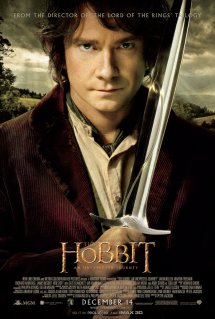
Movie Review: "The Hobbit: An Unexpected Journey" Part 2 and three things you might like

I think sometimes how nice it must be for ordinary people. People who can watch television without becoming so fixated on a particular show that they stay up until two in the morning watching every episode they can get their hands on, and then researching it until sunrise on Wikipedia and TVTropes.com when the episodes run out; people who don't find themselves crying on the subway because of the ending of a book they finished a week ago; people who aren't elated or depressed for days because of how much they liked a movie adaptation of a property they enjoyed in the past.

I don't know what it's like not to live so deeply in my imagination, to not feel my breath get short and my blood pressure rise, to not be physically affected by the stories and fantasy worlds created by others. I wonder sometimes why I care so much about these things, why it matters a jot to me or anyone else if DC Comics re-boots their universe, or why I feel the need to write 2000 words on what I thought about "The Hobbit" and then come back to write another 2000 words on the same subject.
I wish I could quit you. Not really. I don't know what I'm saying!
 On the other hand,  it's people like me who end up creating these kinds of things. Peter Jackson didn't spend years of his life and destroy his health (seriously, look at pictures of him at the Oscars ceremony when he won all the awards for "Return of the King," he looked like the Goblin King, it was shocking) making movie adaptations of his favorite books because he wanted the pay day. He did it because he loved them. He's a fanboy, a literal fanatic about Tolkien's creation, and these movies are all good because he cares about things that ordinary people dismiss as trivial, unimportant, or too dorky to think about.

So I don't feel too bad about my obsessions. I'm in good company.

I said in my previous review that everywhere "The Hobbit: An Unexpected Journey" deviated from the source material, either to make the movie more exciting or to make it match up more with LOTR, it didn't succeed. The flip side of that is that everywhere the movie stuck to the book, it came off beautifully. I can't emphasis enough that if you grew up with this book, read it at night with your parents, or play-acted it in the backyard with your friends, your heart is just going to soar when you see about half of this movie.

Again, let's put the big damn SPOILER ALERT here for both the movie and the book.

1) The acting is superb. I'm a big fan of the BBC "Sherlock" television show, so when I saw that Dr. Watson was going to be Bilbo Baggins, I was very pleased. Martin Freeman is perfectly suited for playing humble, somewhat flustered characters that have an underlying toughness and resourcefulness to them, and he shines as Bilbo. I can't say enough good things about him, so I'll leave it at that.

In fact, everyone is wonderfully cast. Jackson changed some fundamental aspects of Thorin Oakenshield's character, and I don't agree with those changes, but I can't argue that Richard Armitage is excellent in the role as it's written. And while most of the dwarves kind of blend together, variety of hats and facial hair notwithstanding, the movie uses that to its advantage by portraying them as a perfectly synchronized eating, singing, fighting machine. There's no pressure to recognize more than three or four of the dwarves on sight; we're encourage to think of them as a single unit because they're stand-ins for an entire displaced dwarf nation.

2) Jackson introduces a thematic element of an entire displaced dwarf nation that wasn't really in the book, but unlike his other additions, this one is both needed and welcomed. I loved the the prologue of the movie showing the dwarves driven out of the Lonely Mountain by the dragon Smaug, because that opens the doors for Bilbo to be motivated by more than just a desire for adventure, as he is in the book. He sticks with the dwarves to help them gain back their home, which is exactly what he longs for pretty much as soon as he leaves the Shire. Adventure is well and good, but compassion and empathy make for much better character interactions, and I'm glad Jackson emphasized that aspect of the story.

3) It's funny! My friend R said that she always liked "The Hobbit" book better than the LOTR books as a child because "The Hobbit" was witty and made her laugh. Tolkien got a lot of comedy mileage by contrasting the dignity and somewhat-faux-heroism of the dwarves with the fussiness and practicality of Bilbo. In some places it seems like the dwarves are characters from the old Scandinavian sagas and Bilbo is a modern Englishman, as though Tolkien is mixing and matching entirely different genres of storytelling and getting humor from their differences.

Although I wouldn't call this movie a comedy, a lot of the humor from the book made it onscreen, mostly thanks to Freeman's Bilbo, who is, again, just a delight. One of the funniest moments for me was when they're all riding through a rainstorm, the dwarves are bitching about the weather, and Bilbo just slouches silently along on his little pony while everything about his posture and his expression screams, "I-hate-it-I-hate-it-I-hate-it." It makes me smile every time I think about it.

Unfortunately, Jackson's sense of humor is a little childish, so there's more snot and belching jokes than I really look for in a movie, me being a grown-ass adult and all. And the contrast between Bilbo and the dwarves, while funny, is more about the one being prim and the others being crude and rowdy. Again, it's a bit juvenile, and kind of misses the point. There isn't really any of that meta-textual humor of Bilbo and the dwarves being characters from different types of stories, probably because these dwarves are heroic and not faux-heroic like the ones in the novel.

I know that I had four things I really didn't like about this movie, and only three things I did like, but on the whole I enjoyed "The Hobbit: An Unexpected Journey" more than I disliked it. I saw it twice, I'd be happy seeing it again if the opportunity comes up, and yes, I'll probably buy the extended edition when it comes out so I can watch the behind-the-scenes specials (and to satisfy my morbid curiosity about how Jackson can bloat this behemoth to an even longer running time than it currently has).

And I get two more Christmas seasons where I can go to the theater and see a Hobbit movie! My holidays are booked solid until 2016, folks!

By the way: Happy New Year and thanks for reading my blog. My radio show starts its spring season on February 5th, and my book reviews will soon be increasing to two per week. The road goes ever on and on...

Thursday, December 27, 2012

Movie Review: "The Hobbit: An Unexpected Journey" Part 1 and four reasons you may not care for it

And so the obsession begins again. You can also read my reviews of "Lord of the Rings" 1, 2, and 3.
You will consume the bulk of my thoughts and actions for the next three years.
 If you're hoping to go into theaters this winter and see "The Hobbit: A Thrilling Prequel to the Lord of the Rings," congratulations, I think you'll thoroughly enjoy about half of this movie. If you're hoping for "The Hobbit: An Adaptation of the Beloved Children's Story," you'll thoroughly enjoy the other half of this movie. The problem with "The Hobbit: An Unexpected Journey" is that it can't commit to being one or the other, and the result is complete tonal whiplash between whimsy and aggressive grandeur.

But let's back up for a moment and talk about the eighties.

My main cinematic influences growing up were Disney, of course, and Jim Henson. Like many children, I watched a lot of Sesame Street, a lot of the Muppet Show and Muppet movies, "Star Wars," and the full battery of live-action fantasy movies with Henson's puppet creations, the most memorable in my mind being "Labyrinth." When you thought of live-action fantasy, you thought first and foremost of Jim Henson's beautiful and whimsically grotesque creations.
And David Bowie's magnificent package.
Fantasy didn't get much better than Jim Henson. That was the problem. I love Jim Henson as much as the next red-blooded American, but he was limited by budget and technology to movies and creations that looked fake. I'm not saying they didn't look good; he certainly knew how to make a fully-realized fantasy world and inhabit it with interesting-looking creatures. And the low-budget-ness art production of "Labyrinth" and "Dark Crystal" is part of their charm. Yes, the rocks are all clearly made of foam and the backgrounds are all matte paintings, but you can say the same of the original "Star Trek" and "Doctor Who" television series. Realism is completely beside the point of these creative properties. They're supposed to take place outside of the real world. It's okay for them to look fake, even aggressively artificial, because it fits thematically with stories set in the realm of pure imagination.
Imagine my slave laborers want to toil in my factory.
Peter Jackson's "Lord of the Rings" trilogy changed all of that. He created the first live-action fantasy film that strove for verisimilitude (and he succeeded because he was given the time and resources to turn the nation of New Zealand into his own personal sound stage). The face of live-action fantasy when from this--

to this:

Not to be hyperbolic, but in terms of the evolution of film, LOTR was basically the moment when we started making tools and fire instead of just squatting in a dark cave cramming moss and raw lizard tails down our gullets.

So it's going to sound a little weird when I say that "The Hobbit" needed less Peter Jackson and more Jim Henson; it needed to be closer to "Labyrinth" than LOTR.

I can remember the exact moment when I had this thought. It was in the scene when the dwarves are captured and brought before the Goblin King in Goblintown. The King makes his "I got you!" speech and has his little minion take a letter, and then the minion goes zooming away down a zip-line in his little cage to deliver the letter. Right then I thought, "Jim Henson lives!" The design of the minion, the way he moved, and the whole concept of that pipsqueak goblin secretary zipping around Goblintown in his cage delivering the words of the Goblin King was straight out of Jim Henson Studios.

It was perfect. Perfect for an adaptation of "The Hobbit." Perfect for a live-action fantasy movie aimed at children. Perfect for the whimsical world of Tolkien's beloved children's novel. This was "The Hobbit" movie I wanted to see.

And there wasn't enough of that overall. There wasn't enough whimsy or charm. There was too much war, too much gravitas, too much--well, I felt like the old Reese's peanut butter commercials: "You got Lord of the Rings in my Hobbit!"

I'm not saying that I disliked the movie. As the BF said after our first viewing, "It wasn't a bad movie. It wasn't even a mediocre movie." It was a good movie (as you can tell by my use of the the phrase "first viewing"). It just wasn't a great movie, because it couldn't decide what kind of movie it wanted to be, or what demographic it wanted to appeal to the most.

Four main examples of where this movie went wrong, and let's put a big damn SPOILER alert at this point for both the movie and the books:

1) Radagast the Brown. Why? Just why? Ten years ago I read LOTR and thanked all the stars in heaven that Jackson didn't feel the need to immortalize Tom Bombadil on screen, but apparently he was just saving that nonsensical embarrassment of a character for "The Hobbit." The only people who would find Radagast the Brown funny or compelling, with the fidgeting and the capering and huge streak of bird shit down his face, are five-year-olds. And you can't take a five-year-old to see this movie! Right after Radagast saves his little hedgehog friend and dashes off on his bunny-sled, he's almost stabbed by a ghostly wraith and gets chased out of an evil fortress by an unholy abomination from the deepest pits of hell. You need to be at least ten, or a very brave eight, to see this movie without screaming and crying and demanding to leave the theater. And yet the rest of us have to suffer through several agonizing minutes with Radagast the Teletubby that don't even advance the main plot.

2) Speaking of things that don't advance the plot, why that long, boring scene of the wizards and elves sitting around a table talking to each other? Saruman, Gandalf, Elrond and Galadrial all gather in Rivendell to discuss the bad shit going down these days. This is the clearest thematic and story tie-in to LOTR, because of course they're really talking about the rise of Sauron, which is kind of a big deal in the other movies. But it's an awful scene. It's boring, grinds the story to a screeching halt, commits the fatal sin of telling rather than showing, and again, I can't imagine who it's supposed to appeal to.

If you read the books, you don't need to be told that the Necromancer is the first sign of the second rise of Sauron. If you only watched the LOTR movies and didn't read the books, you'd at least recognize that the evil ghost in the  big scary castle is one of the Ringwraiths that were heavily featured in all three LOTR movies. Gee, could there be a connection there? And if you didn't read the books and didn't watch any of the previous movies, then all this means nothing to you and will just leave you wondering why you're wasting your time with these tall magical people talking gravely at each other, when you paid good money to watch thirteen short hairy people and one short fussy person go on an adventure.

3) The subplot with the Pale Orc seeking revenge against Thorin made me roll my eyes so much they nearly fell out of my skull. The BF railed hard against this character. "So now we have to sit through this stupid son-must-avenge-the-father revenge story? It cheapens the whole movie! It wasn't in the book and anyway it's been done! It's been done to death, and it's not what "The Hobbit" is about! Why?"

The weird thing is, I can see the reasoning behind the character of the Pale Orc and his blood-feud with Thorin. It's meant to make Thorin more like Aragorn in LOTR (they even look alike, what a coincidence), to give him nobility and a higher purpose in this story than just reclaiming gold and treasure from Smaug the Dragon. It's also meant to spice up the story by giving Jackson an excuse to show some of the Dwarf and Goblin Wars in flashback, which, I admit, looked pretty cool on screen but don't otherwise figure into the main story at all.

But even though the Pale Orc subplot was much more interesting and advanced the story more than the two previous examples on this list, it's actually the one I hated the most. Thorin isn't Aragorn. He isn't the dark, brooding hero reluctantly stepping forth from his self-imposed exile to accept his great destiny. Thorin in the book is pompous, long-winded, a little arrogant, and a little too eager to call himself King and lay claim to greatness he doesn't necessarily achieve. He's not exactly a hero in the traditional sense, but he thinks he is, and that's what makes him compelling.

The problem from a movie-making perspective is that all of Thorin's best character development comes at the end of the book, when the dwarves have recovered the treasure and Thorin sits in his grandfather's seat as King Under the Mountain. And if you're a movie director making "The Hobbit" into a trilogy, you can't wait until the second half of the last movie to explore what Thorin Oakenshield is really about. Which brings us to...

4) This movie is too long for the amount of story it tells. As soon as the credits started to roll after almost three hours of footage, the BF and I both said, "I want to see a theatrical cut of that movie." We wanted "The Hobbit: An Unexpected Journey" with the fat trimmed off, without Radagast, the mini-Council of Elrond, or the Pale Orc, which really belong in the extended edition of this movie, not in the theatrical release (if they even have a place in this movie at all, which I don't think they do). If this is what Jackson created with the extra time and breathing room he has by making "The Hobbit" into three movies, I'm thinking that he should have stuck with his original plan to just make two. Almost everywhere he's added to or deviated from the source material, it was intended to make "The Hobbit" more like "Lord of the Rings" in either story or tone, and those were inevitably the worst parts of the movie.

Because here's the thing: "The Hobbit" can clearly stand on its own as a movie, without allusions to the rise of Sauron or parallels to LOTR characters. The parts of this movie that were done right, that made me smile and made my heart soar, were lifted straight from the pages of the book: the party that Bilbo reluctantly hosts for the rowdy dwarves in his hobbit-hole; the scene with the trolls in the woods; and the whole glorious sequence in Goblintown where the dwarves and Gandalf fight their way out out of the mountain while Bilbo trades riddles with Gollum beside the subterranean lake. Those were all in the book and they all translated perfectly to the screen.

Jackson didn't need the extra stuff, and he should have known better, considering what and who came before him. The elements that make "The Hobbit" a great fantasy story on the big screen are the same elements that Jim Henson & Co. were using in their movies for years, probably because they were influenced by "The Hobbit"! Watch "Labyrinth," "Willow," or "Legend," and you'll see traces of "The Hobbit" everywhere: the reluctant every-man leaving his/her comfort zone, the bumbling but well-meaning sidekicks, the dragons and goblins and trapdoors and slides through caves (lots of cave-slides, it's one of the more random fantasy tropes). That was why I wanted more Jim Henson in Peter Jackson's "Hobbit," because Henson already knew that whimsy and charm and erudite villains were what made Tolkien's book a classic, not monsters holding aloft bloody severed heads or politicians sitting around tables talking about war. That's what LOTR is about, I'll grant that; but that's not "The Hobbit."

I want to stress again that "The Hobbit: An Unexpected Journey" is not a bad  movie. It's a good movie, a damn sight better than any other live-action fantasy ever made before LOTR. If LOTR hadn't been made and all we had was "The Hobbit," I'd say it's the best fantasy film ever. I feel the same way about "The Dark Knight Rises," that if it was the only superhero movie to come out after Joel Schumacher's "Batman Forever" it would be the best superhero movie ever. But I wrote such a scathing review of "The Dark Knight Rises" because it followed a couple of truly stellar superhero movies ("The Dark Knight" and "The Avengers") and a decade of not-stellar but still-good superhero movies, starting with "X-Men" in 2000 and "Spider-Man" in 2002.

It's no longer enough for fantasy and superhero movies to be good-enough, they have to be better-than. We've gotten fat and spoiled on the geek offerings of our age, loath to accept whatever scraps are tossed our way now that we've feasted at the table of billion-dollar Oscar-winning blockbusters. I feel a bit bad about tearing this poor movie to shreds because it doesn't meet my completely unrealistic expectations for being the best thing ever. I've seen it twice, after all, and enjoyed myself both times.

So in my next post, I'm going to list the things I liked about "The Hobbit: An Unexpected Journey," because there was a lot to like and I don't want to be the kind of critic who can only criticize.

Wednesday, June 29, 2011

Lord of the Rings: Return of the King

"The Lord of the Rings: Return of the King" has 7 endings. I counted. And one of those endings has 3 sub-endings within it, so we're talking about 1 ending for every 45 minutes of the entire 14-hour extended edition trilogy. I'm not going to name all of the endings, because we've got a lot to cover today and I still have a parade and a musical to write about, but I just want everyone to be on the same page.

Ten endings. But the movie needs every one of them, because while Fellowship had just 1 linear storyline, and Two Towers had a hefty but still manageable 3, ROTK is juggling anywhere from 3 to 7 separate storylines at any given moment. At the midpoint of the movie, about two hours in, here is a rundown of the action: Gandalf leading the troops of Minas Tirith; Pippen caught up in the chaos of the burning city; mad Denethor plotting to commit suicide and take Faramir with him; Aragorn, Legolas and Gimli taking the Road of the Dead; Theoden and Eomer mustering the Rohirrim; Eowyn and Merry riding in disguise with the Rohirrim to battle; Frodo and Gollum climbing to the giant spider; Sam cast out by Frodo on the stairs of Minas Morgul. The movie seamlessly weaves all of these stories together without sacrificing good pacing, character development, or emotional resonance.

Watching Fellowship for the first time, I was enchanted. "Look at the pretty elves, look at the ugly goblins, how will our heroes get out of this jam?" Watching Two Towers, deep in the midst of my nerdy obsession with "The Lord of the Rings," I was exhilarated. "Such a faithful adaptation, so much gallantry, oh cost and the glory of battle!" (Never things I said out loud, life was difficult enough in high school without talking like a Renaissance Fair groupie.) But watching ROTK--there's a scene in that movie where the enemy is about to break down the main gate of Minas Tirith with the big wolfshead battering ram, and Gandalf says to the soldiers, "Whatever comes through that gate, you will stand your ground," only to flinch back in consternation as "whatever" turns out to be fully armed and trained cave trolls. That's what watching ROTR was like. I thought I knew what was coming through the gate. I had no clue how powerful it would actually be.

I think by the time Peter Jackson & Co. were putting together ROTK, having already released the first two movies and seen the audience response, they were a lot more certain and sure of themselves. In Two Towers especially, there's a bit of hesitancy in the switch between storylines, which was cleared up in the theatrical version but really shows in the stuttery pacing of the extended edition, like the filmmakers were unsure where and when to go from Helms Deep to Osgiliath to Fangorn Forest. But in ROTK, they not only seem more confident in their ability to handle multiple storylines, they actually embrace it.

I'm thinking of the scene where Denethor sends his son Faramir out on a suicide mission to retake Osgiliath from the 100,000 Orcs that now hold it. While Faramir and a scant 100 or so knights on horseback ride across Peleanor Fields to Osgiliath, Denethor tucks into a hearty lunch and Pippin sings a slow, haunting little song in the empty, echoing hall. Now, I respect Peter Jackson and can't say enough good things about his movies, but in many ways I think he is a very conventional filmmaker. No one is every going to call him an auteur or say his movies are "experimental." (Example: one of the reasons Lord of the Rings holds up so well, 10 years later, is he eschewed CGI whenever he could, relying on techniques as old as film itself, like forced perspective, matte paintings, and miniatures. You could almost call him old-fashioned.) But that scene in the hall is a truly masterful and original piece of film, so wholly different in tone, pacing, sound, and editing from every other battle we see in these movies. Pippin's song would be sad enough, overlaid as it is on that pitiful company of men riding in slow motion to certain doom, but coupled with the sight and sound of Denethor snorking down his lunch, it becomes a heartbreaking and biting commentary on war itself (which is pretty bold for a movie where the opposing army is the literal manifestation of evil, so you don't have to feel bad when they all die horrible, horrible deaths at the hands of our heroes). The mad lord devours red tomatoes and red wine and cracks apart turkey bones to suck at the meat, like he's eating the bodies of the men he's just sent out to die in his name. The young man sings, the horses hooves pound, the knights yell, and the Orcs draw back their bowstrings for the killing strokes, but it's all muffled, drowned out by the smacking, gulping and chewing of Denethor in his beautiful, empty throne room. The arrows fly silently. We never even hear them hit their targets. And to cap it off, a shot of Gandalf, the most powerful wizard in the realm, who defeated 10,000 Orcs at Helms Deep, now slumped with despair in an alleyway, staring hopelessly at a pile of empty wooden crates as if they were the coffins of the dead.

Damn, I love this movie.

Now let's discuss the parts that made everyone in the theater applaud. Legolas bringing down that oliphant. Yeah, that was pretty sweet. Sam rallying Frodo for one last push up Mount Doom to destroy the Ring. "I can't carry it for you, but I can carry you!" I get goosebumps just typing that. And thank you, all my fellow audience members, for clapping at that scene and not repeating last week's incident of giggling awkwardly because you can't help seeing teh queer everywhere you look (weirdos).

My favorite, the Witch-King gripping Eowyn by the throat and hissing, "You fool, no man can kill me," and Eowyn whipping of her helmet and proclaiming, "I am no man!" just before she stabs him in the face. In. The. Face! HUGE cheer for her big moment, probably the loudest of the evening. I was going to write something like I'm glad she finally stopped crying and just stabbed a dude in the face, but now that I think about it, most of the male characters in ROTK cry as much as she does, so I guess I'm pleased that Eowyn has shown us a woman can be a bit of a weepy mess and still stab dudes in the face. (Not even in the heart or across the throat, but right between the eyes! Or where the eyes would have been if he wasn't a demon-ghost. Not even Aragorn stabbed his enemies in the face, and he ended up being king. Eowyn is harsh, my friends, harsh indeed.)

Nobody clapped for the death of Gollum, though. I suspect that most people feel a bit conflicted about the character. Like Sam, we look at him and feel repelled by his ugliness and contemptuous of his creeping, servile whining. But like Frodo, we feel a bit of pity for him, too, ragged, friendless creature that he is, wanted nowhere and by no one. And the strange thing is, both reactions are correct. Sam is right not to trust Gollum, because the little fucker betrays them at every turn, driving Sam and Frodo apart, delivering Frodo to the giant spider, and biting Frodo's finger off to get the Ring (he and Eowyn should hang out). But Frodo is right to show Smeagol mercy (and isn't it significant that Sam calls him Gollum and Frodo calls him by his pre-Ring name), because it really isn't Smeagol's fault that the Ring drove him mad and twisted his body into his present form. We like Frodo well enough because he's the hero of the story, but he knows and the audience knows that the only difference between him and Gollum is time. Just like Denethor is Faramir's true enemy in the scene above, not the Orcs at Osgiliath, Gollum isn't Sam and Frodo's true enemy, though Sam often thinks he is. The enemy is the Ring, and the Ring works through Gollum, who is the Ring's longest running master except for Sauron himself. They were together for 500 years, Smeagol and his Precious. Whatever mental anguish Frodo endures as the Ringbearer, whatever connection he feels to the Ring, he knows it's a pale candleflame compared to the furnace of need and madness Smeagol must feel toward it.

You want to have some fun? Watch Two Towers or Return of the King and every time Gollum speaks in his evil-Gollum voice, as opposed to his somewhat friendlier Smeagol-voice, imagine that it's actually the Ring speaking. The Ring is an inanimate object and can't talk, and Sauron is a big eyeball of fire and can't talk, so Gollum is the closest we'll ever get to hearing the voice of pure evil. Just a little thought experiment for you, my precious.

In the end, Gollum is a necessary evil. Frodo can't bring himself to destroy the Ring in Mount Doom, but Gollum does it for him, not on purpose, but because he wants the Ring for himself. I think it's significant that the hero couldn't vanquish evil without help from evil itself. Gollum swore an oath to "serve the Master of the Precious," and he broke his oath to Frodo. Frodo warned him, "The Ring is treacherous, it will hold you to your word," and he's right. Gollum breaks his word many times over and into the fire he falls. But he takes the Ring with him, because the Ring is so powerful and evil that it can't be defeated by the forces of good, which it will always tempt, overwhelm and consume. But only the Ring CAN be defeated by the weakness that lies at the heart of all evil things. The Ring rewards Gollum's treachery with a treachery of it's own, but that final betrayal on the part of the Ring was its own undoing. Compare the fate of Isildur, who took the Ring from Sauron ("But the Ring betrayed Isildur to his death," we learn in the prologue) to the look of stunned betrayal on poor Gollum's face as he burns in the lava and silently implores the Ring to save him, or at least explain why. The Ring always betrays. Betrayal is the only way to defeat it.

God DAMN, I love this movie. The books and the movies were such a big part of my life at a time when I was turning into the functional member of society you see before you today, that even now, 10 years later, I can bond with perfect strangers in the movie theater over our mutual love of Lord of the Rings. It's actually the best part of nerd culture, that sensation of instant recognition of a kindred soul.

I've been working on this post for hours now and I'm still finding things to say on the subject, long after I'm sure most of you have lost interest and gone to look at porn. (You heathens.) I guess I just don't want to have to sign off on this post and say goodbye again. The first time around, when I saw ROTK in theaters and knew that this was it, there wouldn't be any more movies, I sort of made a fool of myself. I'm a big girl now, I can admit it. I wept so much at one screening that my friends refused to go with me to see it again "because you cried too hard and didn't want to talk about it afterward." "It's all just so SAD!" I wailed. "Frodo can never go home again! The Ring utterly destroyed him and he saved the world but it doesn't even matter because evil touched him too deeply and now he has to go across the sea to die and NO, he DOESN'T go to live with the elves, it's a METAPHOR for DEATH, didn't you read the Appendices?" (It's a miracle I still had friends to alienate.) But the weird thing is, I felt the same way after this special screening, years after I've moved on to other obsessions, years after I stopped having a copy of Lord of the Rings permanently resting on my nightstand, years after I stopped watching my copies of the movies. I still felt the ineffable sadness of seeing good friends sail off into the west, no matter how much I wanted them to stay.

Welp, I guess I'll go look online and see if they posted any new pictures from Peter Jackson's "The Hobbit"!

Thursday, June 23, 2011

Lord of the Rings: The Two Towers

Another Tuesday, another 4-hour stretch of watching "Lord of the Rings" in theaters. The first time I saw this movie, me mum took me out of school in the middle of the day so we could catch the very first screening on the day the movie opened. This was on the Big Island, so there were no midnight screenings, but she probably would have taken me to see it then if there were. "I know what's important to you," she said. I love me mum.

The second movie of the trilogy, "The Two Towers," is considered by some (I'm glad this is the Internet and I don't need to back up this claim with any real numbers) to be the best of the set because it happens in the middle of all the action and doesn't have any of the slow set up of "Fellowship" or the long denouement of "Return of the King." It's just swords, battles, and creepy goblins for three hours, at least in the theatrical version. The problem with the extended edition is that most of the added scenes are the slow, character- and world-building bits that were really interesting to me when I was deep in my LOTR obsession, but now I feel like they mess with the pacing of the movie and slow it way, way down. I was in the theater for over two hours before the big battle sequence at Helms Deep even began! That's a bit excessive when you can't stop the movie at the halfway point to have a biscuit and a cuppa, which may be why there were a lot more candy wrappers rustling in the theater this time around. Everyone learned their lesson from last week.

One big problem with "The Two Towers" extended edition is, I'm sorry to say, the extra scenes with Merry and Pippin. When TTTEE first came out, I was really excited to see more of the duo, because their adventures in Fangorn Forest with the Ents were my favorite part of the book. I liked seeing those adventures realized on screen. However, after several years of not watching the movies OR reading the books, I find their extra scenes are just too at odds with the tone of the rest of the movie. The slow pacing and the casual jocularity of the characters' relationship belongs more to "Fellowship" than to "TTT." Aragorn, Gimli and Legolas are battling to the death with Saruman's forces, Sam and Frodo are adrift in enemy territory with only a schizophrenic little freak to guide them, and Merry and Pippin are--hanging out drinking magical tree-water? The theatrical version played it just right, because Merry and Pippin went straight from being prisoners of war to trying to convince the Ents to join the battle, knowing that every precious moment the Ents deliberated, innocents were dying. The extended edition adds scenes that actually squander the suspense built up in the first two story lines, and almost trivialize Merry and Pippin's role in the wider story.

Speaking of scenes that just don't fit, poor, poor Eowyn. She is EXTREMELY ill-served by the addition of extra scenes between her and Aragorn. In the theatrical version, she's a capable, stalwart woman of the court, holding strong against the war on her doorstep and the treachery within her own household even as she rages against the societal constraints that prevent her from fighting for her kingdom. She weeps when her cousin and the heir to the throne dies, but even in her grief, she resists the allure of Grima Wormtongue, a man who was able to ensnare the king with his words but cannot sway the princess. When Aragorn calls her "a shieldmaiden of Rohan," you believe that this is a true woman warrior who could conceivably be a better match for him than Arwen. The extra scenes waste all of that and turn Eowyn into a weepy, simpering little fool who throws herself at a man who seems rightly embarrassed at her increasingly desperate bids for his approval. Even worse, some of these scenes are set right next to extra flashbacks between Aragorn and Arwen, which cruelly highlight Eowyn's deficiencies as a character and make it even clearer that her romantic efforts are wasted. In their attempt to give the character some depth, the filmmakers actually flatten Eowyn out and turned her into a romantic comedy cliche. Very disappointing.

But enough fangirl bitching. Let's talk about an extra scene that not only worked, but should have been included in the theatrical version. Faramir of Gondor, the younger brother of the Fellowship's Boromir, gets a long flashback that shows the brothers and their father Denethor hanging out before Borormir leaves to visit Rivendell and eventually join the Fellowship. Boromir is a prominent character in "Fellowship," and Denethor figures heavily into the events of "Return of the King," so TTT is obviously meant to be Faramir's chance to shine. In the theatrical version, we don't know a lot about Faramir. He seems pretty capable at killing enemies and being all Robin Hood-y in the forest, and when he finds out that Frodo has the Ring, he quickly pulls a Boromir and decides to take the Ring to Gondor, which probably seems like a good idea when you're the last line of defense against Mordor and you're living inside a waterfall. But Faramir is NOT Boromir-lite, and the flashback shows an entirely different motivation for the character's actions. It's the only scene we ever get between all three family members, and considering how much influence they all have on each other and how strongly their storyline comes into play in "Return", I really feel that this should have made it to the original cut. Their whole situation is so Shakespearean: Denethor loves Boromir more than Faramir, and both brothers know this but love each other, which makes Boromir ashamed of his status as favorite and Faramir both jealous of his brother and ashamed of his jealousy. When Faramir decides to take Frodo and the Ring to Gondor, he's doing it because he wants to honor Boromir's memory, but also to please his father and show Denethor that he, Faramir, is plenty awesome and could do what Boromir could not. It's hard to fault him when we've seen what Denethor thinks of his younger son. "Do not trouble me about Faramir, I know his uses and they are few." Gee, thanks Dad.

When I first read the books, Faramir was hands-down my favorite character because he possessed such clarity and insight into the whole war for Middle Earth situation happening all around him. He's the only one to openly suggest that war has no true winners and that violence, even violence for a good cause, is a fundamentally evil thing. Everyone else, even the hobbits, are so concerned with the tasks in front of them and are trying so hard to just stay alive that they never stop to reflect like Faramir does. This is fine, because it's sword and sorcery and no one really wants to read a book or watch a movie about a bunch of hippies sitting around talking about war and peace. We want to see some burly warriors kicking ass and taking names. But what sets LOTR apart from all of the other fantasy that followed it was Tolkien's willingness to give Faramir's concerns about the true cost of war as much credence as any other character's perspective. In the movie, Faramir says bitterly, "War will make corpses of us all," which is a little simplistic rendition of his viewpoint, but a pretty audacious thing to say when you've just killed a bunch of dudes and their elephant. In the book, he explains himself at length: "But I do not love the bright sword for its sharpness, nor the arrow for its swiftness, nor the warrior for his glory. I only love that which they defend." (Full disclosure, this was my quote in my senior high school yearbook, because yes, I am a massive nerd.) Either way, this is a peaceful little dude at heart, clinging to his compassion and humanity in a world where such traits will only get you a quick Orcblade in the gut.

After Mum and I watched TTT, I mentioned offhand that her nickname for me, My Precious, was the same name Gollum gives the Ring. "I know," Mum replied, "where do you think I got that name for you?" Which is sweet, but also kind of creepy.

I don't have a lot to say about the extra scenes with Sam, Frodo and Gollum, mostly because I didn't notice any. I know there were some added, but it's been so long since I saw the theatrical version, and that whole storyline is so well plotted and paced, that it just slides by without notice, which is great. If the filmmakers have done their jobs right, there should be seamless integration, not clumsy plot-hindering side adventures (Merry and Pippin) or glaring omissions (happy family time with Denethor & Sons). Anyway, I've got some stuff to say about the character of Gollum, but I'll save it for "Return of the King."

Oh, and one last thing: watching these movies in the theater again is a strange experience because you get large audience reactions to stuff that you've long since regulated to the solitary entertainment part of your brain. "Fellowship" had a lot of people giggling at Legolas's lines for reasons I couldn't figure out (maybe because he tends to be Captain Obvious when he speaks). And TTT got a lot of giggles in Sam and Frodo's climactic scene, when Frodo has his sword against Sam's throat and Sam implores, "Don't you know your Sam?"

Now, I know why people were laughing: haha, Frodo and Sam are gay for each other! But here's the thing. And maybe this is just because I live in New York City and I'm interested in queer theory, but that scene is not gay. In a case like this, sexuality lies in the context of the viewer. Maybe someone could construe the relationship between Frodo and Sam as homoerotic, but only if they have never seen any entertainment with ACTUAL gay characters in it before. For those people, allow me to give you a visual aid.

This is not gay.

This is gay and the most used picture on this site.
In the interests of gender parity, this is also gay.
See the difference? Just so we're clear, deep and abiding friendship between two people of the same sex does not mean said people are gay. It is a nasty and pernicious byproduct of our patriarchal culture that men and women (but mostly men) are not permitted any physical displays of love and affection, such as hugging, or allowed to share deep emotions, such as vulnerability, with friends of the same sex lest they be damned as "gay." This only happens when being gay is considered a bad or transgressive act by society, which doesn't just hurt gay people, but straight people, too, because we find ourselves denied the basic comfort of holding a good friend's hand. Individuals may find that they have to actively battle against such negative societal messages within the space of their own mind in order to break free of such constraints and NOT ruin the most goddamn poignant scene in one of my favorite movies because you can't handle any hint of teh queer.

Wednesday, June 15, 2011

Watching Fellowship of the Ring in theaters--again!


Last night, the BF and I made a special nerd pilgrimage to the movie theater to see a one-night-only screening of "Lord of the Rings: Fellowship of the Ring" extended edition. I saw this movie six times in the theater, or maybe I'm thinking of "The Two Towers" and I only saw this one three times. I can't remember because it was ten years ago.

Ten. Years. Ago.

Fellowship came out Christmas 2001. Jeez, that makes me feel so old. I've been obsessed with these movies for an entire decade. I haven't watched the movies in a while, probably years at this point, but I found that I remembered every single line of dialogue in Fellowship. Hell, I even remembered the DVD commentary for certain scenes! Why I am using memory space for such things? At least I didn't dress up for the screening. I have my dignity.

Actually, nobody was cosplaying last night, which was a bit weird. I'd expected to see at least a few people rocking a ring necklace and bare feet, maybe a sword or two. But no, for the most part it was a mixed bag of young professionals, people old enough to have read a first edition in a haze of potsmoke and Pink Floyd, and couples. Lots and lots of couples. And you know, that gives me hope, hope that one day society will retire the stereotype of the fat, unhappy loner male nerd and embrace the nerd community as it really is: pretty damn normal, actually.

Fellowship holds up very well after 10 years: acting, special effects, sound, music, all of it top shelf movie magic. The version we watched, in addition to be the extended cut, was also digitally remastered for Bluray, so the whole thing was just freaking gorgeous! I saw details I'd completely missed before (and considering I knew every word of the movie by heart, that's really saying something).

It was a bit slower than I remember, probably because it was the extended edition, which means more gently cavorting hobbits and uneventful slogging through rough terrain. I think it takes over 2 hours to get to the action scenes in the Mines of Moria, but man, when it does, I'm just as blown away as I was ten years ago. The music and the pacing during the staircase scene, and Gandalf standing down the Balrog on the bridge--it gives me chills all over again. Lothlorian slowed the movie again and it actually sort of dragged during the giving of the gifts scene. I actually almost fell asleep, but that's probably just because it was late and the music is very soothing.

So here I am, ten years later, remembering an afternoon in 2001 when a friend said, "Let's go check out that Lord of the Rings movie, I heard it was pretty good." I'd seen a single teaser for the three movies almost a year before--just a shot of all 9 members of the Fellowship coming over a ridge and looking majestically determined. And some people in the audience were batshit excited, but a whole lot more were like, "Huh, that sounds familiar, didn't my parents read me a a little of that when I was a kid or something?" The books had a big cult following, but it was still just that, a cult classic. And Peter Jackson had one solid, Oscar-nommed movie under his belt, "Heavenly Creatures," but was himself mostly a cult hit for slasher horror flicks like "The Frighteners." New Zealand wasn't know for having ANYTHING Hollywood wanted, much less a world class special effects studio. Nothing about this project should have worked, and yet Jackson got the rights, New Line Studio ponied up the cash (and stayed out of the way because New Zealand is really, really far away from anything), and those plucky Kiwis spat out a masterpiece. As Jackson says in the special introduction he recorded just for these screenings, "It really felt like fate that we got to make Lord of the Rings." It was a labor of love on a blockbuster budget, and it was pure magic.

Ten years ago, after I got home from watching Fellowship, I got my mom's copy down from her shelf and read the entire Lord of the Rings in a single weekend. I've been hooked ever since, and I can't wait to see "The Two Towers" next Tuesday--and then "Return on the King" the Tuesday after that!